
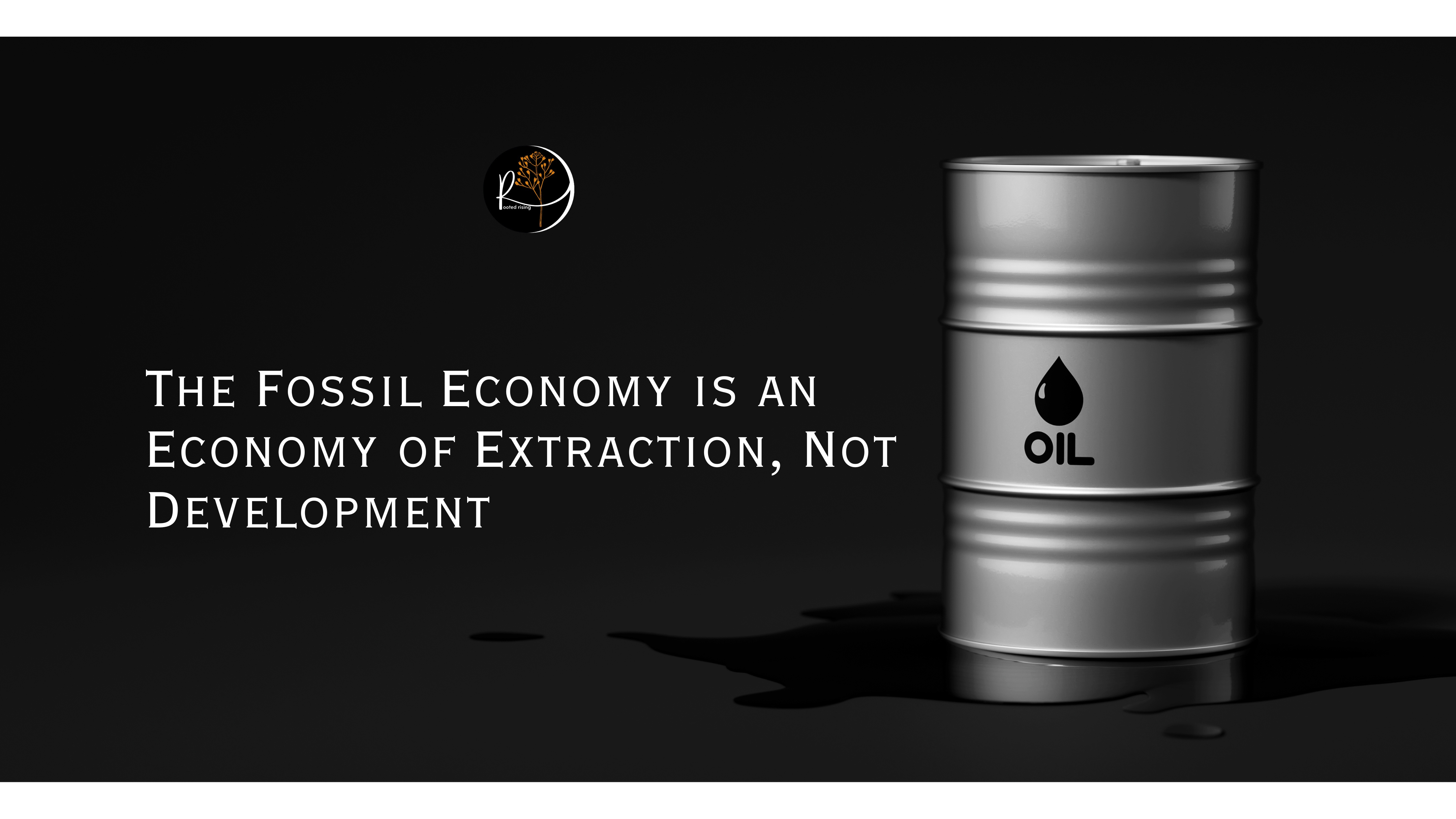
The Fossil Economy is an Economy of Extraction, Not Development
Date Uploaded: October 06, 2025
Categories: Article
For decades, the world has known the Niger Delta as the heart of Nigeria’s oil wealth—a region that fuels the nation’s economy but bleeds quietly beneath the weight of extraction. The irony is haunting: the land that feeds the nation’s power grid cannot feed its own people. The rivers that once shimmered with life now reek of crude. And the people who should be prosperous are instead victims of pollution, displacement, and silence.
This is why we must advocate against the fossil economy—not just as environmentalists, but as human beings who believe in justice, dignity, and life itself.
1. The Fossil Economy is an Economy of Extraction, Not Development
In the Niger Delta, oil did not bring progress; it brought pipelines, high militarization, pollution and conflict. The roads are broken, healthcare is absent, and the air is thick with gas flare smoke. What kind of economy extracts billions of dollars from a region and gives back poisoned water in return? The fossil economy was never designed to develop—it was designed to drain.
2. Communities Bear the Cost While Corporations Count the Profit
Every oil spill is a crime scene. Yet, no one goes to jail. Villagers watch their farmlands burn and their children fall sick, while oil companies file “incident reports” as if documenting a routine accident. The fossil economy thrives on invisibility—it hides behind corporate jargon while real people suffer toxic realities. The people of Ogoni, Otuabagi, and Oloibiri know this truth too well.
3. The Fossil Economy Breeds Inequality and Injustice
The Niger Delta’s story is not only about oil—it’s about power. The fossil economy concentrates wealth in the hands of a few and leaves entire communities disenfranchised. It sustains a cycle of exploitation where the poor pay with their health and the rich profit from their silence. True justice demands that we dismantle this imbalance—not just reduce emissions, but redistribute power.
4. Gas Flaring is a Crime Against the Future
Every night, the sky over the Niger Delta burns. Gas flares roar like angry suns, lighting up the darkness but dimming our future. They emit more carbon than entire countries, contributing to the global climate crisis. And yet, they continue because profit outweighs principle. Advocating against the fossil economy is also about protecting our atmosphere—the shared home of humanity.
5. Transition is Not a Luxury—It’s Survival
For the Niger Delta, transitioning away from fossil fuels is not a trend; it’s a necessity. The soil is dying. The fish are gone. The people are migrating. A fossil-free future is the only path that honors both people and planet. Imagine a Delta where mangroves heal the waters again, and where young people find jobs not in oil rigs, but in innovation, farming, and restoration.
6. Because Silence is Complicity
To stay silent is to endorse the slow death of the Niger Delta. Advocacy is no longer a choice—it’s an act of survival. Speaking up against the fossil economy means choosing people over profit, regeneration over extraction, and life over convenience. It means reminding the world that what is happening in the Niger Delta is not an isolated tragedy—it’s a mirror reflecting what happens when humanity prioritizes greed over grace.
The call is clear:
The fossil economy must end—not gradually, but justly. The future cannot be built on a foundation of flares, spills, and broken promises. The Niger Delta has given enough. It’s time we give back—to the land, to the people, and to the generations who will inherit what we choose today.
We are all surrounded.